I'm a strict empiracist. As a scientist I trust the well-observed data only, and only the data I trust. Everything which comes after the data, when a paper is published, is opinion and easily ignored.
Here's why.
Good science is the use of good data to make a theory, which can predict the behavior of matter. That makes it testable, and the theory can be sustained by some test, or eroded. If eroded, throw the theory out. It's just no good.
"It doesn't matter how beautiful your theory is, it doesn't matter how smart you are. If it doesn't agree with experiment, it's wrong." ~ Richard P. Feynman
But this isn't how most people use what they consider science to be. To non-scientists, or poor scientists, an explanation or a hunch serves as a theory. Ideas that don't rise to the level of hypothesis will serve. What most people seek is a story to explain their experience, not a theory. Or worse, what actually happened.
This has to be a constant problem for lawyers dealing with witnesses. I've seen it many many times with lab students trying to make sense of their notes. We've all done it trying to explain what happened when we have forgotten part of the past.
Having a story makes it possible to "remember" what happened without recalling some, or any, of the details. This ability to remember a story is one of the creative artist's saving graces.
It's also caused a lot of fights. Particularly in science, when we forget the reason we hold the theories we do, or in politics, when we don't know why we hold the opinions that drive our behavior.
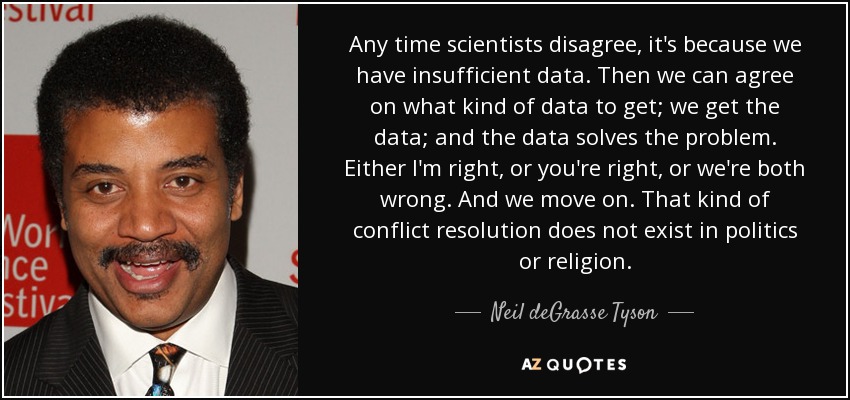
Prediction is an essential part of the scientific method. It's how we test hypotheses. But scientific prediction is never about the future. It's about things that are immutable in time. Measure it any time, and you'll get the same measurements. Predictions about the future are something else entirely.
As I said, I am a strict empiracist. If any prediction fails, it's done. I hope scientists understand that when I trash their work. Poor hypotheses will get trashed; it's the inevitable fate of bad science, or call it "incomplete science" (if you're being kind).
But predictions about the future is another thing altogether. That isn't science. The entirety of the data we know about the future will, and always will, fit inside an electron. There just isn't any. And there can't be any. It hasn't happened.
But many people predict things about the future. The old Coast-to-Coast-AM radio show with Art Bell used to have have many soothsayers on, and even had a new years activity where callers predicted the future, and the next year Art would "bong" the bad predictions. That was for fun. Why do we make predictions about the future? Because we've found a story to explain our past, and it's no trouble extending the same behavior into the future.
Do we have a good explanation of our past? Are our stories any good? Can they really predict the future? No. Sometimes someone gets lucky and describes a future which come to pass, at least in part. And part is good enough for most folks. But those who have made a good prediction in the past are well known for faililng in the future. In politics, no one who every got it right has always thereafter been right. It's easy to find pollsters who got Trump's victory, then loss, then victory wrong each time. Or wrong at least once. A nice testable outcome. Now, having gotten it wrong, did they stop making predictions? No. It's not because we now trust them, they just won't shut up. Once they are wrong, they will keep making predictions until they are right again. It's tiresome.
But the worst of the predictors of the future seem to be the climate scientists. And these are they who should know better.
Alas, it is always dangerous to prophesy, particularly, as the Danish proverb says, about the future.
~ 1956, Journal of the Royal Statistical Society: Series A (General), “Proceedings of the Meeting”, [Speaker: Bradford Hill], Page 147, Volume 119, Number 2, Blackwell Publishing for the Royal Statistical Society.
Some have sensed that the public is begining to turn on them. Having predicted both an ice age, then a super-hot future over the last 40 years, and having neither one arrive, the failings of the climate predictors have become noticable. Instead of calling them "climate scientists," they are being called "climate activists." They themselves are calling it climate activism now. Michael Mann, once one of the leading predictors of global doom, sued two guys for saying he was full of it. And instead of winning a million bucks, was forced to pay a million bucks because he made up data to influence the court.
What does it mean when someone predicts the future, and it dosn't happen? It means their version of reality is wrong. They are living by stories to explain their lives which are wrong. It means that when they ponder what they've been through, they come up with the wrong conclusions. And how does that happen? Narcisism, addiction, insanity, those are the easy ones. Narcicists, the addicted, and the insane are all well-known for not understanding their own reality. And it makes them all dangerous, because they will tell you about how they will behave in the future, behavior which will not happen. They are lying to you, because they are lying to themselves.
And when a scientist predicts a future which doesn't happen? They are also lying to themselves.
And that's why I have a zero-cred opinion of failed predictions about the future from any scientist: They have lied to themselves about why they are even trying to predict the future, and about what drives the future. Those failues are absolutly massive in science. Any scientist who has predicted the future, and it didn't happen, has zero credibillity with me. About everything they have ever said or written, until someone else has produced fact enough for me to confirm their theories myself.
And there is one other way to make my zero-cred list: no know how to use measured numbers. But that's for a different post.