You hear that a lot. It's hyperbole, and it never really changes anything.
But imagine if the physicists said one day, "Sorry, the speed of light is not what we've told you all this time. The universe is only 6000 years old."
Or if the chemists said, "Sorry, atoms aren't really a thing. Alchemy is probably the way to go."
Or biologists said, "Sorry, we just didn't know what we were doing with that whole evolution thing. It's not real"
Well, that just happened in climate science.
The IPCC in January invalidated the RCP8.5 scenario for climate prediction: https://gmd.copernicus.org/articles/19/2627/2026/
I need to explain what this means. RCP stands for "Representative Concentration Pathway" and it means the concentration of the greenhouse gasses that trap some infrared heat in the lower atmosphere. Instead of figuring out how the economy creates greenhouse gasses, they slapped together, back in 2005 or so, a model that makes a lot of assumptions, primarily the concentration of greenhouse gasses. The "8.5" is the assumed amount of heat that is trapped, in this case 8.5 watts per square meter. The sun delivers, at noon, about 1100 watts per square meter to the surface of the Earth. Depending on the albedo of the surface (how white it is) this light is either reflected back into space, or it is absorbed and heats the surface if it's black. The hot surface then emits infrared (IR) radiation back into space, but greenhouse gasses can intercept some of this upward-heading IR radiation and scatter it back to the surface. The RCP8.5 assumes that 8.5 W of the IR comes back to the surface. Those who invented the RCP8.5 stated explicitly it was never to be used as a baseline for the Earth's climate; it was only good for testing models.
There are a lot of these scenarios proposed by the IPCC for calculating future climate change. From RCP1.5 to RCP8.5, differing levels of an essentially un-measurable number are proposed so that researchers who develop and use models for the climate are to run them all chose which best reflects reality. And they each used completely different assumptions; the only thing they share in common is the name. All to be used for testing models, not predicting the Earth's climate.
But that's not how the scenarios were used. When the climate papers came out, all scenarios were calculated, then only the RCP8.5 discussed. Other papers jumped right to the RCP8.5 and ignored the others. Within about 5 years it was considered the primary baseline scenario for the future. My big question as a scientist is why did they do this? RCP8.5 is a very extreme scenario, implying that all energy comes from wood or coal and oil. It implied that all hydroelectric, nuclear, solar shut down. And it implies that society radically transform itself back to the start of the 1900s. Wood and coal stoves for heating and cooking. Really extreme stuff here. So extreme it's called the "doomsday scenario," not because of what it predicts, but because of what needs to happen to make it a reality. A reality that can't happen.
And 95+% of publishing climate scientists, when they had to choose a scenario, chose RCP8.5. Why?
Using RCP8.5 for anything, much less using that as the only model, looks like idiocy. 30 years ago it seemed a silly model, but for 30 years it's used almost exclusively in talking about the future, and it's the only one you've heard described in the news or elsewhere. It's Al Gore's baby. It's almost every climate scientist's baby. It's as if the gateway to getting published in the field is to use the RCP8.5 as your only or main model.
And now it's known to be just plain wrong. It describes a future that can't possibly happen.
And the consequence? Nearly every paper published in climate science over the last 20 YEARS is now WRONG. Invalid. Impossible. An entire field wiped out.
And all those news storied about the future? All WRONG. Invalid. Impossible.
And all the political drives to "save the planet?" All WRONG. Invalid. Impossible.
There hasn't been anything like this in science ever. There have been revolutions, but they were to replace something good with something better. This is different. This is a field saying they were wrong for no good reason other than they ignored reality. Or maybe they were just stupid. Or maybe they so liked the fame from being in the news that they dropped any pretense of science and went with the fleeting glory of reading their names in the paper. Who knows. It infects almost the entire field of climate science, and the best hope they have of surviving this is that the public is too stupid to recognize what they did. Which might be true, but I doubt it.
But the big take away is rather huge: climate science has never been a science. Is just some guessing by people who clearly aren't all that bright. Weathermen all.
So what are the climate guessers to do now? They can withdraw the probably 100,000 wrong papers and maybe try to reset all the bad ideas they generated. They are tainted forever by this, and can't be trusted to produce anything trustworthy for decades, or until they all leave the field. Retire and get a job at Wal-Mart. That would be useful.
There are a few left who can think. I hope they can manage this mess and get climatology fixed so that the predictions have a chance of being right. Maybe regain some trust. But as a field, climate science is now dead. It died by suicide.
Here is a great post by Roger Pielke Jr, a climate scientist who is actually a scientist, and who, with Justin Richie, realized that the climate scenarios being used described a planet, just not ours: https://rogerpielkejr.substack.com/p/how-climate-science-lost-its-way It's a wonderful read as a summary of the paper that started the takedown.
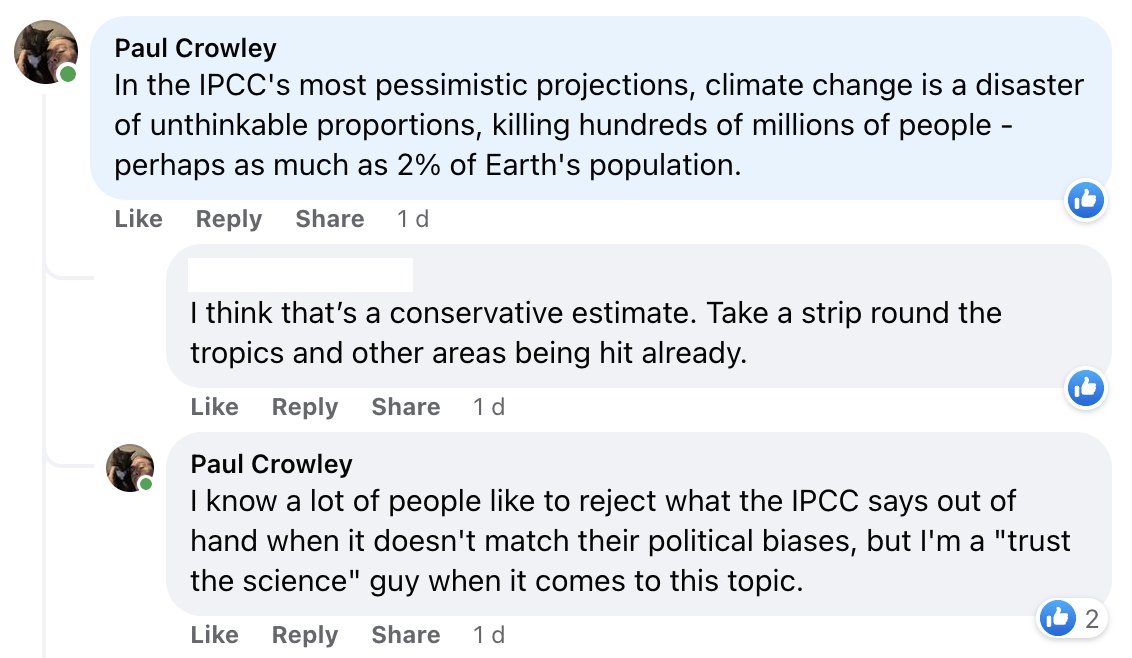
And I'd correct this guy: trust reality. Science is always going to change.